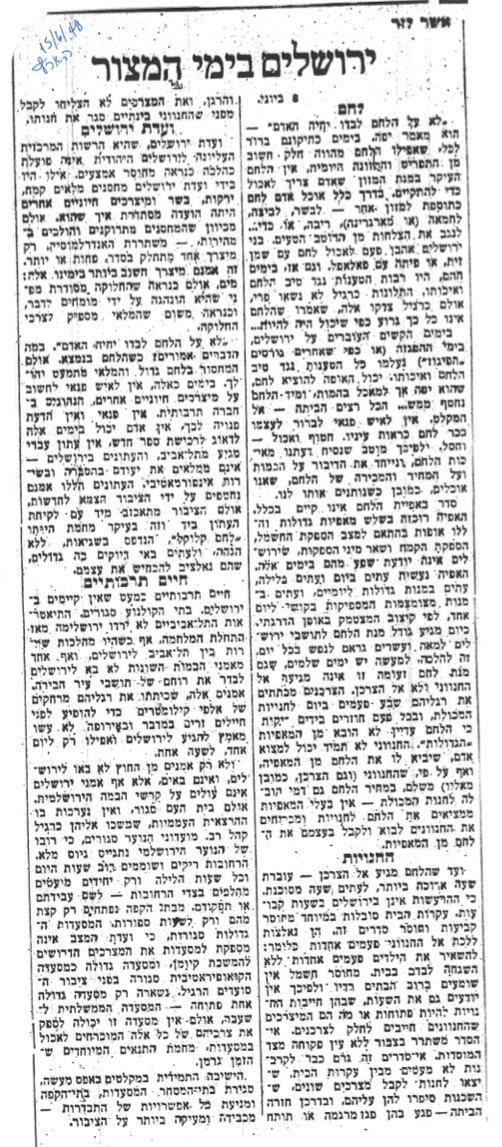
The 1948 siege of Jerusalem by Arab armies reduced daily life to chaos—bread rations unreliable, shops dangerous to reach, cultural life extinguished—leaving residents preoccupied only with survival under bombardment.
Bread
“Man does not live by bread alone” is a beautiful saying. In ordinary times, it is clear to all that even though bread forms an important part of the daily diet, it is not the main element of the food a person needs to survive. Typically, people eat bread as a supplement to other foods—meat, eggs, butter (or margarine), jam, or even to wipe up sauce from a tasty plate. Jerusalem’s residents once loved eating bread with olive oil or pita with falafel. Even in those days, there were many complaints about the quality of bread. The complaints, as usual, bore no fruit. Yet, as always, those who claimed the bread wasn’t as bad as it could have been were right.
During the difficult days of the siege on Jerusalem, during the bombings (or as some call them, “the shellings”), all complaints about the quality of bread disappeared. Bakers could produce bread fit only for animals, and it would be snatched up immediately. People rushed home—to the shelters. No one had time to choose their loaf of bread as they saw fit. “Grab and eat” became the motto. Thus, it became permissible to disregard the quality of bread and focus on its quantity, price, and distribution—if, of course, it was available.
There is no set pattern to bread baking at all. Baking is concentrated in three large bakeries, which operate based on the availability of electricity, flour, and other supplies—commodities that Jerusalem sorely lacks these days. Baking occurs sometimes during the day, sometimes at night, and sometimes in large quantities for two days, while at other times in small quantities barely sufficient for one day. Currently, the daily bread ration for Jerusalem’s residents is 120 grams per person—this is in theory. In practice, there are entire days when even this meager ration fails to reach shopkeepers or consumers. Consumers often visit grocery stores multiple times a day, returning empty-handed because the bread has not yet arrived from the “large” bakeries. Grocers cannot always find someone to bring the bread from the bakery. Even though the grocer (and naturally, the consumer) pays delivery fees, bakery owners do not deliver the bread to the stores, and force the grocers to collect the bread themselves.
The Shops
By the time bread reaches the consumer, a long time has passed, often during a dangerous hour. Bombardments in Jerusalem occur at no fixed times. Housewives suffer especially from the lack of order. They must visit grocers multiple times, leaving their children unsupervised at home. Due to the lack of electricity, most homes do not listen to the radio and therefore do not know when shops will be open or what products grocers are required to distribute. This lack of oversight by government institutions has led to chaos, costing the lives of many housewives. Women, having gone to collect goods after hearing about their availability from neighbors, were killed on their way back home by mortar or artillery shells. Often, they were unable to procure the goods because the shopkeeper had already closed the store.
The Jerusalem Committee
The Jerusalem Committee, the highest central authority in Jewish Jerusalem, apparently lacks the means to function properly. If the committee had full warehouses of flour, vegetables, meat, and other essential supplies, it might manage somehow. However, as the warehouses are quickly emptied, anarchy prevails. Only one essential commodity is distributed with some degree of order—water. The water distribution appears organized because it is managed by experts and likely because the supply is sufficient.
“Man does not live by bread alone” applies only when bread is available. The bread shortage is severe, and the stock is dwindling. In such times, people have no time or mental capacity to consider other essentials of civilized society. There is no time or thought for buying new books. No Hebrew newspapers arrive from Tel Aviv, and Jerusalem’s newspapers fail to fulfill their role of providing information. While newspapers are snatched up by the news-hungry public, readers are immediately disappointed by poor printing, numerous errors, and inaccuracies that sometimes require retractions.
Cultural Life
Cultural life in Jerusalem is almost nonexistent. Cinemas are closed. Tel Aviv’s theatrical productions have not come to Jerusalem since the war began, even when convoys traveled between the two cities. None of the performers who entertained soldiers abroad in Europe or in the desert have made an effort to reach Jerusalem, even for a single hour.
Not only have outside performers avoided Jerusalem, but even local artists have ceased performing. The People’s House (Beit Ha’am) is closed, and public lectures that once drew large crowds no longer take place. Youth clubs are shut down because most of Jerusalem’s youth have been fully mobilized. The streets are empty most of the day and all night, with only a few individuals out walking for work or duty. Most cafes are closed, opening only briefly. Large restaurants are shut down due to the emergency committee’s inability to supply them with necessities. Even the cooperative restaurant is closed. Only one large restaurant remains open—the former government restaurant—but it cannot meet the needs of all those who must dine out due to the extraordinary circumstances.
Constantly sitting idle in shelters, the closure of shops, restaurants, and cafes, and the lack of entertainment opportunities, weigh heavily on the public.