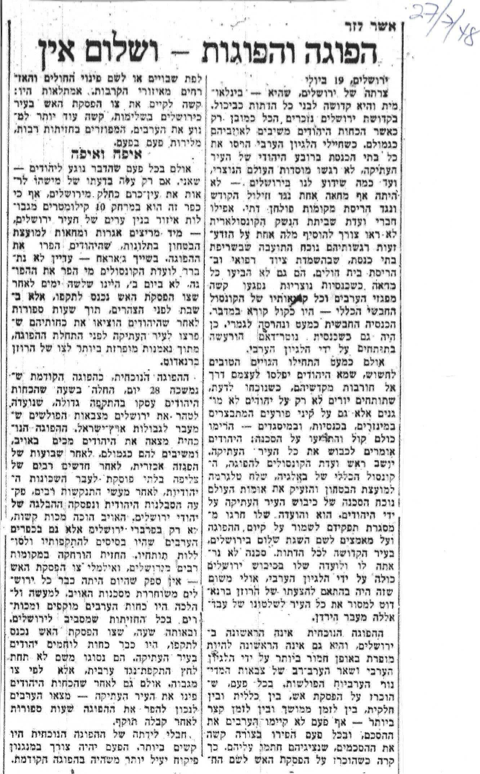
Jerusalem’s fragile July 1948 truce exposed glaring double standards, with Arab forces repeatedly violating ceasefires while international committees condemned Jewish defenses but remained silent on the widespread destruction of synagogues, churches, and hospitals.
Jerusalem, 19 July
The tragedy of Jerusalem is that it is international and considered sacred by people of all religions, ostensibly. The sanctity of Jerusalem becomes a topic of remembrance only when Jewish forces retaliate against their enemies. When soldiers of the Arab Legion destroyed all the synagogues in the Jewish Quarter of the Old City, Christian world institutions did not stir, and as far as we know in Jerusalem, not a single protest was made against this desecration and the destruction of places of religious worship. Even the members of the Consular Armistice Committee felt no need to utter a single word of outrage over the atrocities of burning synagogues, destroying medical equipment, and demolishing hospitals. They also did not voice any protest when Christian churches were severely damaged by Arab shelling, and all the calls of the Ethiopian Consul General fell on deaf ears. The Ethiopian Church was almost completely destroyed, as was the case with the Notre Dame Church, which was shelled by the Arab Legion.
However, the “good gentiles” began to worry almost immediately, fearing that the Jews might make their way to the ruins of their temples. Upon realizing that cannons were fired not only at unprotected Jews but also at nests of rioters hiding in monasteries, churches, and mosques, they all raised their voices, warning of the danger: the Jews were planning to capture the entire Old City. The Chairman of the Consular Truce Committee, the Consul General of Belgium, sent a telegram to the Security Council and alarmed the nations of the world over the danger of the Jews conquering the Old City. He and his committee overstepped their role of maintaining the truce and working towards achieving peace in Jerusalem, a city sacred to all religions. The occupation of all of Jerusalem by the Arab Legion seemed to pose no danger to him and his committee, possibly because it aligned with Count Bernadotte’s proposal to hand over the entire city to the rule of Abdullah of Transjordan.
The current truce is not the first in Jerusalem, nor is it the first to be gravely violated by the Arab Legion and the rest of the invading armies of the Arab states. Every time a ceasefire was declared, whether general or partial, long or short-lived, the Arabs never adhered to the agreement. Each time, they severely violated the agreements that their representatives had signed. This happened during ceasefires declared for prisoner exchanges or to evacuate the sick and civilians from battle zones. The excuses were always the same: it was difficult to implement the ceasefire order completely in Jerusalem, and even more difficult to prevent scattered Arab forces from firing intermittently.
Double Standards
However, when it comes to the Jews—it’s a different story. If anyone dares consider Ein Kerem part of Jerusalem, even though this village is 10 kilometers away from the city’s built-up areas, complaints and protests are immediately sent to the Security Council, accusing the Jews of breaking the truce. In Sheikh Jarrah, the Consular Committee determined who violated the truce, not on Monday, three days after the ceasefire came into effect, but on Saturday morning, just hours after Jewish forces withdrew from the Old City in exaggerated compliance with Count Bernadotte’s orders.
The current truce, like the previous one lasting 28 days, began when Jewish forces were conducting a major offensive aimed at clearing Jerusalem of invading armies from beyond the borders of Israel. The current truce found the Jews striking their enemies and retaliating against them. After weeks of brutal shelling, months of continuous sniper attacks on Jewish neighborhoods, and numerous acts of violence, the patience of Jerusalem’s Jews wore thin, and their restraint ended. The enemy suffered severe blows, not only in Jerusalem’s suburbs but also in the Arab villages that served as bases for their attacks and artillery batteries. The front lines were pushed back in many areas around Jerusalem, and without the ceasefire order, the entire city would likely have been liberated from the enemy’s threats by now. In practice and principle, the Arab forces were surrounded and besieged on all fronts around Jerusalem. At the very moment the ceasefire order came into effect, Jewish fighters were already in the Old City. They withdrew not under pressure from an Arab counterattack but by higher command. Yet, even after Jewish forces evacuated the Old City, the Arabs deemed it fit to violate the truce mere hours after it took effect.
The birth pangs of the current truce were very difficult. This time, a more efficient monitoring mechanism will be necessary than was in place during the previous truce.