In May 1948, Jewish forces captured and held the Notre Dame de France Monastery just seven meters from the Old City walls, repelling repeated Arab Legion assaults. Despite heavy fighting and difficult conditions, the mostly young Haganah and Lehi fighters maintained high morale and turned the site into a stronghold for defending Jewish Jerusalem.
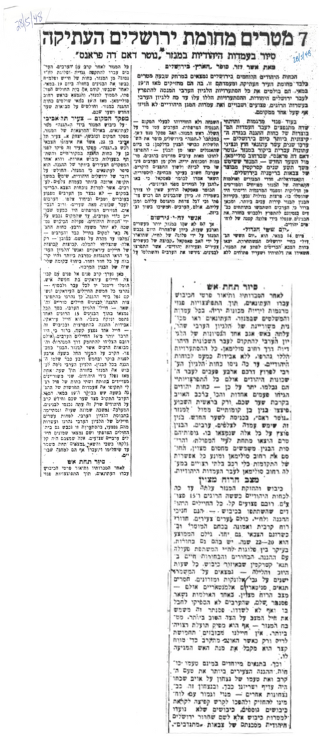
The Jewish fighting forces in Jerusalem are stationed only seven meters from the walls of the Old City. From this position, which they have held since May 19th, they have repelled all assaults by the Arab Legion attempting to break into Jewish Jerusalem. These assaults have cost the Arab Legion dozens of dead, wounded, and captured soldiers, without displacing the Jewish defensive positions by even an inch.
While mortar shells and field artillery bombard the fortified defense positions in Jerusalem’s most extreme sector, twelve foreign journalists and representatives of the Hebrew press visited the Notre Dame de France Monastery on Suleiman Street, opposite the New Gate. This monastery served as a fortified barracks for British forces in Jerusalem for nine years.
The cathedral, living quarters, and reception halls of the monastery are charred and scarred by fires, mortar rounds, and grenades. Large breaches have appeared in the thick stone walls, indicating that the Arabs used heavy artillery in their attempt to reclaim the buildings that had fallen to a small group of Jewish fighters.
“The Great Friday”
On May 14th, known as “The Great Friday” in the history of liberated Jerusalem, British forces suddenly evacuated the monastery, leaving its doors and gates open and unguarded, without returning it to its owners – the French Church. The Arabs immediately seized the opportunity. The head of the monastery, Father Pascal Saint-Jean, recounted the building’s capture in a letter to the Jerusalem defense: On the same day the British left, hundreds of armed Arabs stormed in with rifles, mortars, and machine guns. Some began looting valuable historical artifacts, while others told Father Pascal they had come “to protect the monks from the Zionists.”
Father Pascal informed them that this protection was unnecessary since the buildings were French property and the French flag protected them. However, the Arabs continued their looting and pillaging.
Lehi Fighters Expel Them
The Arabs did not remain in the monastery for more than twenty-four hours. The next day, a Lehi unit, described by Father Pascal as “a group of about twenty young Jewish men and women,” stormed the buildings, expelled the Arabs, and seized control after a battle. The Arabs counterattacked, forcing the Lehi unit to retreat. Haganah and Palmach forces recaptured the buildings on May 19th after first taking the nearby French Hospital at the top of Suleiman Street. Since May 19th, the defense forces have controlled the monastery, overseeing the New Gate and Damascus Gate.
Location Commander – A Young Native of Tel Aviv
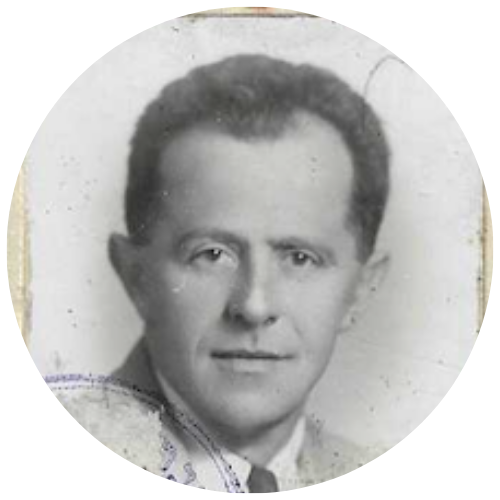
The capture of the monastery by the Haganah was reported to journalists in the monastery’s lecture hall by its commander and conqueror, 22-year-old Yitzhak A…, a young Tel Aviv native who received his military training in the Haganah. This young commander had previously led Haganah forces in Makor Chaim, participated in other capture operations, and was one of the youngest commanders in the Haganah. He told journalists that the monastery, which overlooked Jewish Jerusalem, had long served as a sniper position for the Arabs. Despite the presence of British forces in the area, the Arabs were not prevented from attacking passersby, particularly targeting the Mea She’arim neighborhood and Nevi’im Street. The French monks had been virtually held hostage by the Arabs until the site was taken by Jewish forces. The takeover operation lasted no more than an hour and fifteen minutes. The Haganah forces arrived in full military strength, and the Arabs quickly fled—of course only those who managed to escape. Groups of Iraqi soldiers and Arab Legion fighters put up fierce resistance, with battles for each room, especially on the third floor of the main building.
Here is where a face-to-face battle took place with a group of five Iraqi soldiers. Hand grenades were thrown in all directions, and in the end, all five Iraqi soldiers were killed, and their weapons fell into the hands of the Haganah. Additionally, Syrian soldiers were killed in the explosion that cleared the buildings, and the rest were Arab Legion soldiers. In total, 15 dead were found inside the buildings, and one was captured and taken as a prisoner. He was an Iraqi soldier. The Haganah’s casualties in this assault and takeover amounted to one soldier who was seriously wounded. It was clear that there were far more than 16 Arab soldiers. However, most of them managed to escape through the monastery’s many tunnels and passageways, as the structure was built like a fortress. The battle for the monastery began at 4:00 AM, and by 5:15 AM, the Haganah had already taken full control of the entire building. The Arab Legion attempted to retake the monastery within an hour of its fall to the Jewish forces. At 6:00 AM on May 19, two armored vehicles equipped with cannons and two infantry platoons attacked the Haganah’s newly established positions. The Arab tank approached from Damascus Gate and launched a renewed battle against the Jewish fighters who had just entered the buildings. The battle lasted eight hours and ended in the defeat of the Arab Legion. At least 20 Arab Legion soldiers were killed, and dozens more were wounded. During this assault, the French Hospital was also captured, where 80 wounded Arab soldiers were found. Those who were lightly injured were taken as prisoners, while the rest remain under guard until they recover and can be transferred to a prisoner-of-war camp.
A Tour Under Fire
After receiving explanations and a description of the details of the conquest, the journalists proceeded through all the positions and strongholds in the monastery, amid explosions of mortar shells and bursts of machine-gun fire. The journalists saw an armored vehicle of the Arab Legion that had been set on fire during one of the Arab Legion’s attempts to advance toward the Jewish neighborhoods via Suleiman Street. All of these assaults were repelled, with almost no casualties on the Jewish side. So far, the Arab Legion forces have tried four times to break through toward the Jewish neighborhoods, but all of their attempts were stopped. Moreover, Jewish forces several times laid ambushes and struck enemy vehicles near Damascus Gate. At the beginning of the week, a two-story building opposite the Notre Dame monastery, at the entrance to the New Gate, was blown up. This building had served as a sniper position for Arabs. The building was blown up with everyone inside. Their bodies have not yet been retrieved from under the rubble, and the ruins of the building now serve as an excellent barricade, blocking Suleiman Street and preventing any unwanted vehicles from advancing up Suleiman Street toward the Jewish positions.
Morale is Excellent
The conquest and retention of the monastery have so far cost the Jewish forces six dead and 15 wounded, most of them lightly injured. All the Jewish soldiers who participated in the conquest are graduates of the Haganah and Lehi. They are all young city dwellers, filled with combat spirit and faith in their moral strength and military skill. Their average age is 20 to 22 years old. There are also women among them, primarily in the Lehi units that cooperate with the Haganah. The men and women live under barracks conditions in the occupied zone. They remain on guard day and night, sleeping on stretchers and mattresses. They lack basic sanitary conditions, but—morale is excellent. In one of the halls, a piano remained intact; the Arabs did not have time to sabotage or loot it. This piano is now used by the garrison to great effect. The monastery’s kitchen is also being put to good use. Our soldiers do not waste ammunition unnecessarily, and only when the enemy approaches within close range does it receive the fire that is due. Thus, under these exceptional conditions, the youngest Haganah forces have tasted both battle and victory against an enemy whose numbers were superior and whose armor was heavier. And with this victory, as with others, our fighters are determined to hold their ground and turn it into a springboard for further conquests—not for the sake of conquest, but for the liberation of Jewish Jerusalem from the threat of “volunteer” armies.