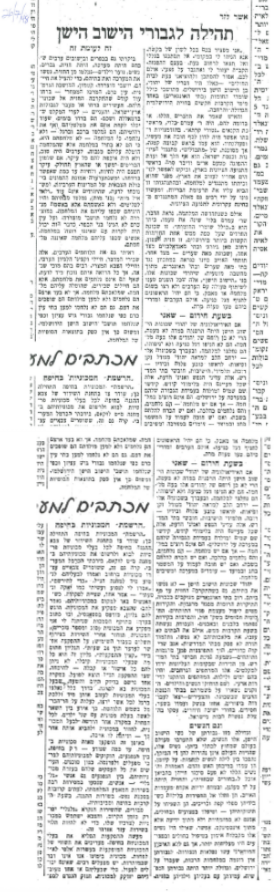
Originally published in Haaretz on 26 July 1948, this wartime article by Asher Lazar depicts the defense of northern Jerusalem during the 1948 war. It highlights the unexpected participation of the Old Yishuv — including residents of Kollel Shomrei HaChomot (the Ungarin Houses) and members of Neturei Karta — who defended their homes under heavy shelling, while contrasting their resolve with the flight of Arab civilians from nearby neighborhoods and portraying Arab Legion and Egyptian forces as fighting a war “not their own.”
“I implore you in every possible way. Please leave me where I am. Do not endanger yourselves on my account and do not go out into the street now, in the midst of the shelling. The Holy One, blessed be He, will help me and I shall overcome my wounds; but you must not risk yourselves in order to take me to the hospital.” – Such were the words of a Jew, a member of the Old Yishuv in Jerusalem, one of the residents of the Kollel Shomrei HaChomot (the Ungarin Houses)[1], during one of the hard days of battle on the broad and extensive Jerusalem front.
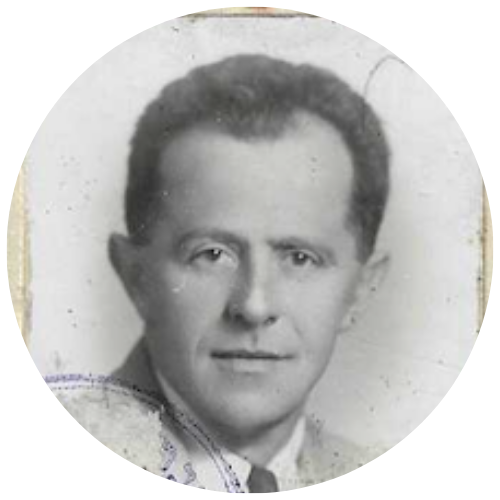
The man who spoke these words, or words to similar effect, was Rabbi Amram Blau, one of the leaders of the zealot sect “Neturei Karta.”[2] On many occasions one could judge his deeds and activities harshly. He stood at the head of a small but dangerous group of “separatists,” opponents of Zionism and of the Knesset Yisrael[3]. He even went before the United Nations Truce Commission and spoke ill of the leaders of the Zionist movement in the country, requesting permission for his followers to leave the land, since he and his faction opposed the war. Through such conduct he incurred public resentment, and his actions were condemned even by many who, in principle, opposed the Zionist movement.
However, when the fighting was renewed, it appeared that Rabbi Amram Blau had changed his tune. His home is in the “Kollel Shomrei HaChomot,” the ultra-Orthodox neighborhood that lies directly at the edge of one of the most difficult fronts in Jerusalem — the northern front: St. George Street and the Mandelbaum Houses on one side, and the Mea Shearim neighborhood on the other. The enemy’s guns were apparently deliberately aimed at the houses of Mea Shearim and the Ungarin Houses, in the mistaken belief that the Jews of these neighborhoods — the people of the “Old Yishuv,” who for years had advocated cooperation with the Arabs and had wanted no war or struggle — would be the first to raise the white flag. But the Arabs and their guides made a bitter mistake.
In Time of Emergency
If the ideology of the Jews of the Old Yishuv neighborhoods was in no small measure destructive, their spirit in time of war was quite otherwise. They did not raise a flag of surrender, nor will they raise one. They went forth into battle, and as one passes through these neighborhoods, the heart expands at the sight of a Jew with flowing beard and sidelocks, a steel helmet upon his head and a rifle in his hands. Yeshiva students, dwellers of the study halls — gentle souls and refined minds, whose entire world had been sacred learning — sanctified the Name of Heaven and of the homeland through their courageous stand in the campaign for Jerusalem. They do not desire war — but if there is war, they fight, and they fight properly. If it is necessary to fight on the Sabbath, and if it is a duty to stand guard on festival days — they stand in battle and return fire.
The Jews of the Old Yishuv neighborhoods did not abandon their homes, even when the front approached their very doorsteps. Most of the Ungarin Houses are riddled like sieves; ceilings are shattered by mortar shells, and the walls lean toward collapse under the force of artillery fire. Windows are blocked with sandbags, breaches in the walls sealed with bricks and stones. The work was done in the midst of battle itself. Yet they did not leave their homes; they did not abandon their occupations; and Torah study did not cease in the study halls. Amid the whistle of bullets and the explosions of mortar and artillery shells, the chant of the students could be heard.
From the upper floors they descended into shelters — the broad cellars — and lived there day and night. The basements were adapted for temporary dwelling; there the women and children were kept. The elderly remained at their posts in the many synagogues of the neighborhood, and the young men went out to fortification work, took up arms, and stood at the gate. Hasidim, pale yeshiva youths, engaged in saving many Jewish lives.
And the Women
Greater still was the heroism of the women of the Old Yishuv — women who had never involved themselves in the world beyond the walls of their homes. These women, unfamiliar with the ways of the wider world, were transformed overnight into fighters for their existence. They stood the test of fire and blood. Not infrequently these mothers and wives risked their lives bringing food to “the boys at the front,” and the front was just beyond the bend of the street, within pistol range of enemy positions. They crawled into the trenches at night, coffee cups and sandwiches in hand. They watched over their infants — and tended to the wounded and the sick, not with professional training or learned knowledge, but by instinct. Had these women received training in the care of the sick and wounded, they might have accomplished even more; yet even without modern instruction they performed wonders. Their heroism has no equal in the many wars that have passed over Jerusalem. Greater still was their moral courage — their steadfastness alongside their husbands and children at the front.
One Against the Other
I also visited Arab villages and settlements where there had been fighting — where there had been a front. Men, women, youth, and children fled the front, abandoned the battle and their homes to save their lives. The residents of Musrara, Katamon, the German Colony, Ein Kerem, the commercial center — fled even before the front approached their neighborhoods. The wealthy fled beyond the borders of the Land of Israel; the poor to the cities of refuge in Ramallah and Nablus. They fled in days when they could still take their belongings and even their furniture. They escaped by vehicle and on foot — and did not fight. For the war was not their war; they did not choose it — it was imposed upon them from above. The Arabs had lived well, and it mattered little to them whether British rule continued or the land was partitioned. Their chief desire was to live, and to live as comfortably as possible. And when the masses’ faith in the military capability of the Arab states was shaken, and when they realized that the Jews were no longer “doomed to perish,” they fled their homes and became refugees — not through their own fault, but through the fault of their leaders who forced war upon them. The residents of Musrara did not fight for Musrara, and Ein Kerem was not defended by its villagers. Such can occur with a people that does not desire war — when war not their own is forced upon them.
I also saw the Arab fighters — desert mercenaries, soldiers and officers of the Arab Legion, and soldiers of the Egyptian army. Many among them were filled with hatred, yet any observer could immediately see that they too were not fighting their own war; they were hired soldiers to whom war had been assigned — war as a profession — but not for their own land did they fight, nor for their homeland did they shed their blood. They did not fight for the houses of Ein Kerem as the heroes of Gush Etzion fought, nor as the residents of the Old Yishuv of Jerusalem fought. And for that reason, there can be no doubt as to the final outcome of the war.
[1] A late-19th-century Hungarian ultra-Orthodox housing complex in northern Jerusalem, part of the Old Yishuv. Located near the 1948 northern front line, it sustained heavy shelling during the war.
[2] For anti-Zionist groups like Neturei Karta, Knesset Yisrael was seen as a secular nationalist political structure, illegitimate from a theological perspective, and an attempt to create Jewish sovereignty before the messianic era. So in this context, the phrase signals opposition to the institutional leadership of the Yishuv, not merely abstract Zionist ideology.
[3] In this article, “Knesset Yisrael” (כנסת ישראל) does not refer to the modern Israeli parliament (which was not established until 1949). Rather, it refers to the organized Jewish community in Mandatory Palestine prior to statehood. It included the Va’ad Leumi (National Council) which was the executive body, the Elected Assembly (Assefat HaNivcharim). This was the official institutional structure representing the Jewish community before the establishment of the State of Israel.