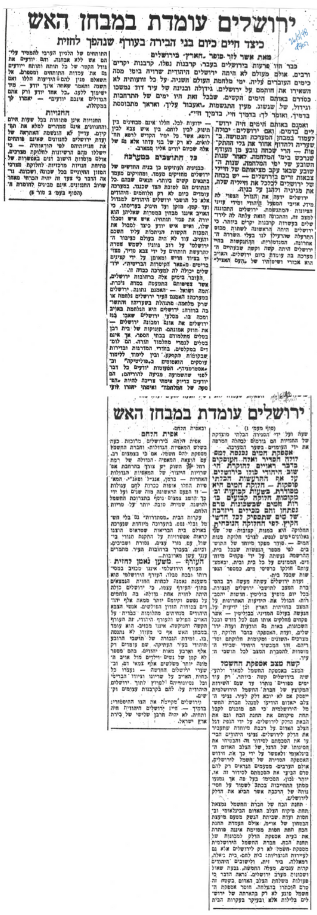
In May 1948, Jerusalem’s Jewish residents managed daily life under siege with limited food, water, and electricity while supporting the city’s defense.
There have been riots in Jerusalem before, victims have fallen, dear and numerous victims. However, never before has Jewish Jerusalem been in such a state of trial as the days it is experiencing now. The days of World War II, with all its horrors, did not leave their mark on Jerusalem. The growth and construction of the City of David continued as usual during those difficult days, which were nonetheless days of expansion and growth, of prosperity, almost like the fulfillment of the verse: “And when I passed by thee, and saw thee polluted in thine own blood, I said unto thee: Live in thy blood, live in thy blood.”[1]
Indeed, in those days Jerusalem lived through blood, and if Jerusalem can stand the test of the battle raging at its gates and repel the waves of attacks – it gained that strength from surplus during the war years. After the years of abundance during the war, which came as a result of the presence of foreign military forces in Jerusalem, Jerusalem can now sustain its own soldiers and defenders and protect its people.
Jerusalem was aware of the fate that awaited it at the hands of enemies of the Jewish enterprise and the adversaries of Zionism realized. Jerusalem prepared for this situation, and this preparation cost it dearly, with tens of precious lives. Jerusalem was the first to drink from the poisoned cup given by the final rulers – the Mandate authorities. The assault on Jerusalem’s existence was severe, and the battle in which Jerusalem now stands is even more difficult. The enemy is cruel, and the methods of the “noble people” are known to all. They do not distinguish between an infant and a fighter, between a soldier and a doctor who has devoted his entire life to healing ailments, not only of his own people but also of those who now ambush and shoot at him.
All Residents in the Battle
Like its ancient buildings, the new inhabitants of Jerusalem are holding out. They endure under the harshest conditions, where all circumstances favor the opposing side. Not only Jewish fighters but all Jewish residents of Jerusalem, from the eldest to the youngest, from the elderly to infants in their cribs, now stand in the battle. The enemy makes no distinction in the targets for its artillery shells. Each person bears their own suffering, and everyone knows how to endure the heavy blows that fall upon them morning and night. Nowhere else in the world has there been a community like that of Jerusalem, with all its diversity, serving as a target for artillery bombardment by a regular army equipped with modern gear and trained by British officers from “the pride of the British Empire.” Jerusalem can withstand this heavy battle.
Anyone walking through the streets of Jerusalem these days, where the crowds have significantly diminished, wonders – is Jerusalem truly under siege? Is the city of Jerusalem at war, or is the war only at its gates? The answer is clear: Jerusalem itself is fighting the enemy and striking it. From the stones of Jerusalem, its people draw their strength, and from its builders – their steadfast faith. Children are not studying in their usual schools but continue to learn in shelters, stairwells, and ground-floor apartments. Between lessons, the little ones engage in “politics” and “strategy.” They know everything before their parents hear the news: they know exactly when the “war break” will be and when the artillery of the Arab Legion will resume raining indiscriminate fire. They even know the caliber of each cannon and the positions and numbers of the guns. If you ask them how they know, and mistakenly claim that you do not, they will mock you. “Everyone knows – only you grown-ups don’t,” they will say in unison.
The Shops
Shops are not open all day, and the shopkeepers are in no rush to perform their duties. The warning from the Jerusalem Committee to those who do not open their stores as instructed – that their licenses for distributing goods would be revoked – has not yet been enforced. However, community institutions are discussing the possibility of opening central stores for distributing essential foodstuffs in each neighborhood. This step seems necessary since most shopkeepers do not comprehend the gravity of the hour, and by unjustifiably closing their stores, they cause panic, weakening the resolve of those at the frontlines.
Water supply has resumed normal operations, and those involved deserve the gratitude of the entire Jewish community in Jerusalem. Despite constant bombardment, water distribution is orderly, at fixed times and designated distribution points. Neighborhood water cisterns have not yet been opened, holding reserves that should suffice for the entire summer under the current distribution system.
The ration is limited to two gallons of water per person. A special census was conducted to facilitate water distribution, registering residents by household size. Inspectors assigned to each house distributed water tickets based on the number of residents.
The Jerusalem Committee has played a significant role in informing the besieged residents of the city. Each day, a news and information bulletin is published, containing the latest updates on the state of the battlefronts across the country, as well as developments in the political arena worldwide. This bulletin – distributed free of charge by inspectors throughout all neighborhoods, also includes announcements from the Jerusalem Committee and the supply committee regarding the distribution of goods, their designated locations, and the procedures for obtaining them. It serves as the sole instrument available to the authorities to communicate the situation to the entire population of the city.
The Electricity Supply Situation is Dire
The electricity supply for lighting and industry in Jerusalem is in dire condition. Only a few days remain before even the current limited service of the Jerusalem Electric Company is entirely discontinued—unless fuel is delivered to the city. Representatives of the Red Cross have informed the company’s management that they are willing to take the power station under their supervision, as well as oversee the transport of fuel to Jerusalem. Their proposal includes placing the Red Cross flag on a special train to ensure the safe passage of fuel shipments. The Jewish representatives have agreed to this arrangement, guaranteeing the protection of the International Red Cross flag in order to facilitate the restoration of a steady electricity supply to Jerusalem. However, the Arabs, for reasons known only to them, have yet to provide their formal consent. They have verbally agreed but have refused to issue a written commitment ensuring the safe passage of the fuel train.
The power station of the Jerusalem Electric Company is under the supervision of the International Red Cross and the ceasefire committee appointed by the United Nations Security Council. However, placing the power station under protection does not resolve the issue of fuel supply needed to operate its machinery. The Jerusalem Electric Company provides electricity not only to Jerusalem but also to the Christian towns of Bethlehem, Beit Jala, Ramallah, and Bir Zeit, as well as to the Jewish settlements of Kiryat Anavim, Ma’ale HaHamisha, Givat Shaul, and the western neighborhoods of Jerusalem. It seems that the Red Cross’s efforts in this matter have not yet borne fruit. The lack of electricity affects not only the lighting of Jerusalem at night but, more critically, the ability of households to function and the ability to bake bread.
Bread Production
Bread production in Jerusalem is now concentrated in three major bakeries, which receive a limited electricity supply from the power company. With the closure of the large bakery in Ramat Rachel, the remaining bakeries—Berman, Angel, and Pagi—must expand their production capacity. For the first time in years, round loaves of bread are being baked, a measure that both conserves electricity and better preserves the freshness of the bread.
Housewives are managing without electricity or kerosene. A special exhibition at the Strauss Health House showcased various methods for cooking using wood, sawdust, and small kindling. Walking through the streets, one now sees smoke rising from chimneys throughout the city…
The Homefront—A Staunch Support for the Frontlines
The residents of Jerusalem’s homefront are unwavering in their dedication and resilience. The homefront is a steadfast pillar of support for the fighters at the frontlines, which, in reality, are within the city itself—because all of Jerusalem has become one vast battlefield. Here, more than one hundred thousand Jews fight for their lives and survival against invading forces bent on destruction. Jewish fighters are delivering heavy blows to the enemy, and the Jewish civilian population—unyielding and steadfast—remains resolute.
Nowhere is the heroism of Jerusalem’s people more evident than in the Jewish Quarter of the Old City, where just 1,400 Jews—including many women and children—stand against an enemy force of more than 30,000 bloodthirsty attackers. At the gates of modern Jerusalem, enemy forces—including their British-armored units—have been halted. Every attempt to breach Jewish Jerusalem has come at an immense cost to the invaders.
And so, Jerusalem fulfills the historic command: “Live in thy blood!” Jewish Jerusalem lives and will continue to live. There will be no third destruction of the capital of Israel.
[1] Ezekiel 16:6