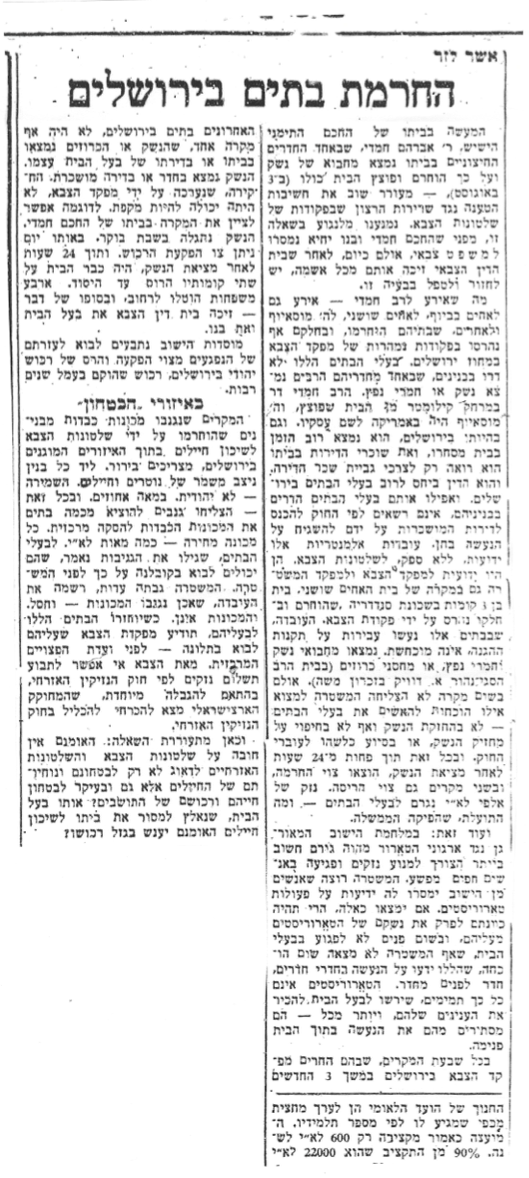
This article focuses on confiscation and demolition of Jewish property in Jerusalem by British Mandatory authorities, and the theft of property utilized by British soldiers that left the owners with no recourse under Mandatory law.
The case of the elderly Yemenite sage, Rabbi Avraham Hamadi, whose home was confiscated and demolished (on August 3) because a weapons cache was found in one of its outer rooms, underscores once again the importance of challenging the blind obedience to military orders. We refrained from addressing this issue earlier because Rabbi Hamadi and his son Yehia were put on military trial. However, now that the military court has acquitted them of all charges, it is time to revisit this matter.
What happened to Rabbi Hamadi also occurred to the Babayof brothers, the Shoshani brothers, Mr. Musayof, and others whose homes were confiscated, and in some cases even demolished, under hasty orders from the military commander in the Jerusalem district. The homeowners did not reside in the buildings where weapons or explosives were found in one of the many rooms. Rabbi Hamadi lived a kilometer away from the house that was demolished, and Mr. Musayof was in America for business. Even when he was in Jerusalem, he spent most of his time in his shop, and only met the tenants of his building to collect rent. This was also true for most property owners in Jerusalem. Even those who lived in their own buildings were not legally allowed to enter rented apartments to monitor activities. These basic facts are undoubtedly known to the military authorities. They were known to both the military and police commanders, including the case of the Shoshani brothers’ house, a three-story building in the Sanhedria neighborhood, which was seized and partially destroyed by army order. The fact that weapons caches, explosives, or even leaflets (such as in the house of the blind Rabbi Dweik in Zichron Moshe) were found is not disputed. However, in no case did the police find evidence to accuse the property owners of holding the weapons, aiding the perpetrators, or being complicit in any way. Yet, less than 24 hours after the weapons were found, property confiscation orders were issued, and in two cases, demolition orders followed. This caused thousands of pounds of damage to the property owners—what benefit did the government gain from this?
Furthermore, in the organized community’s fight against terrorist organizations, a critical principle is to avoid harming innocent people. The police want citizens to provide information about terrorist activities. If such informants were to be found, the intent would be to neutralize the terrorists’ weapons, not to harm property owners who, as even the police acknowledge, had no knowledge of what was happening in their buildings. Terrorists are not so naive as to let property owners know their activities and go to great lengths to conceal their operations.
In all seven cases where the Jerusalem military commander seized homes over the past three months, not once were the weapons or leaflets found in the owners’ personal residences or apartments. The weapons were found in rented rooms or apartments. The investigations conducted by the military commander could not have been thorough. For example, in Rabbi Hamadi’s case, the weapons were discovered on a Saturday morning. That same day, a confiscation order was issued, and within 24 hours, the house, including its two floors, was demolished. Four families were left homeless, and eventually, the military court acquitted the owner and his son.
Community institutions are called upon to assist those harmed by the confiscation and destruction of Jewish property in Jerusalem—property built through years of labor.
In the “Security Zones”
Cases of heavy machinery being stolen from buildings confiscated by the military for housing soldiers in protected areas in Jerusalem require clarification. At every building, there were guards of both police and soldiers—were 100% not Jewish. Despite this, thieves managed to remove heavy central heating equipment from several buildings, with each machine worth hundreds of pounds. When property owners discovered the thefts, they were told to file complaints with the police. The police recorded statements and confirmed the thefts, but the matter ended there. The machines remain missing. When these buildings are eventually returned to their owners, the military command will instruct them to file complaints with the central compensation committee. It is impossible to sue the army for damages under civil tort law due to specific limitations set forth by the Mandatory legislator.
This raises the question: is it not the duty of military and civil authorities to ensure not only the security and comfort of soldiers but also, and especially, the safety and property of residents? Should a homeowner forced to house soldiers also bear the loss of their stolen property?