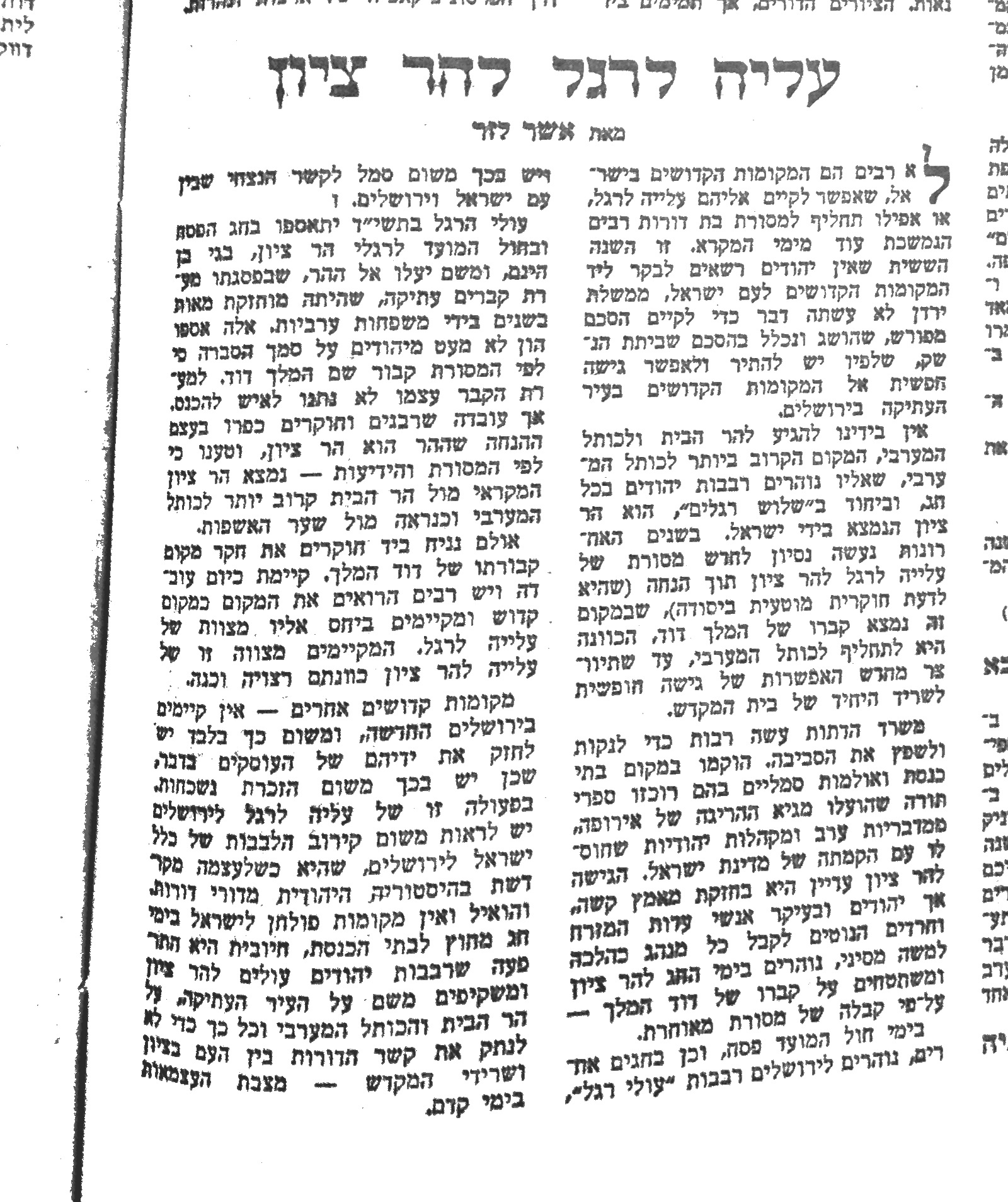
In 1954, with Jews barred from the Old City and the Western Wall, Mount Zion became the focus of pilgrimage, where tens of thousands gathered during festivals to honor what was believed to be King David’s tomb and to preserve the Jewish people’s connection to Jerusalem.
Haaretz, 5714 (Spring 1954) (exact date of publication in Ha’aretz not yet determined)
There are not many holy places in Israel where one can make a pilgrimage, let alone an alternative to a tradition that spans generations and has its roots in biblical times. For six years, Jews have been prohibited from visiting the holy sites of the Jewish people. The Jordanian government has done nothing to uphold an explicit provision of the armistice agreement, which stipulated that free access to the holy sites in the Old City of Jerusalem must be granted.
We cannot reach the Temple Mount and the Western Wall. The closest site to the Western Wall that draws tens of thousands of Jews during festivals, particularly the three pilgrimage festivals (“Shalosh Regalim”), is Mount Zion, which is under Israeli control. In recent years, an attempt has been made to revive the tradition of pilgrimage to Mount Zion, based on the belief (which researchers deem fundamentally mistaken) that King David’s tomb is located there. The intention is to create an alternative to the Western Wall until free access to the only remaining relic of the Temple is restored.
The Ministry of Religious Affairs has done much to clean and renovate the area. Synagogues and symbolic halls have been established there, housing Torah scrolls brought from the ruins of Europe, the deserts of Arabia, and Jewish communities that were eradicated with the establishment of the State of Israel. Access to Mount Zion remains challenging, but Jews, especially Sephardic Jews and ultra-Orthodox individuals, who are inclined to accept any custom as law, flock to Mount Zion during holidays and prostrate themselves at what is believed to be King David’s tomb, according to a late tradition.
During Passover and other holidays, tens of thousands of “pilgrims” make their way to Jerusalem, symbolizing the eternal connection between the Jewish people and Jerusalem.
In 1954, pilgrims will gather during Passover and the intermediate days of the Festival at the foot of Mount Zion, in the Valley of Hinnom, and from there ascend the mountain. At its summit lies an ancient burial cave, held for centuries by Arab families who made considerable profits from Jewish visitors under the belief that King David is buried there. They did not allow anyone to enter the burial cave. However, rabbis and researchers have questioned the premise that this site is Mount Zion, arguing that biblical Mount Zion is located opposite the Temple Mount, closer to the Western Wall, possibly near the Dung Gate.
Nevertheless, we leave the question of King David’s burial place to scholars. What remains is the fact that many regard the site as sacred and fulfill the mitzvah of pilgrimage in relation to it. Those who undertake this pilgrimage to Mount Zion have sincere and genuine intentions.
There are no other holy places in modern Jerusalem, and for this reason alone, the efforts of those promoting this activity should be supported. This act of pilgrimage to Jerusalem fosters unity among the Jewish people and Jerusalem, a city sanctified in Jewish history for generations. Since there are no places of worship outside of synagogues during festivals, the phenomenon of thousands of Jews ascending Mount Zion, gazing upon the Old City, the Temple Mount, and the Western Wall, serves to maintain the unbroken bond between the Jewish people in Zion and the remnants of the Temple—a monument to independence in ancient times.