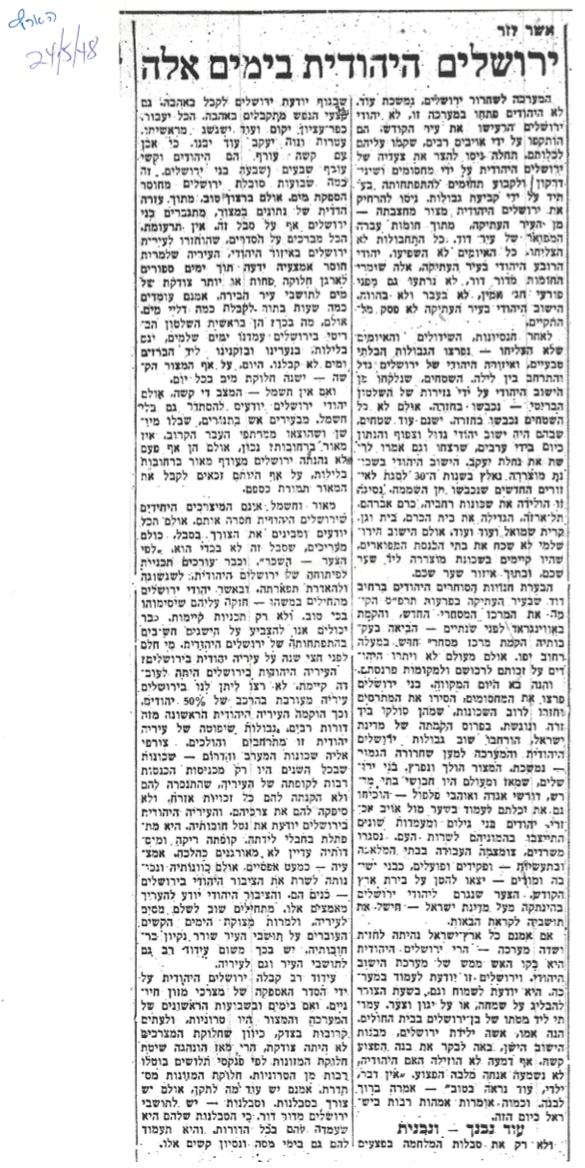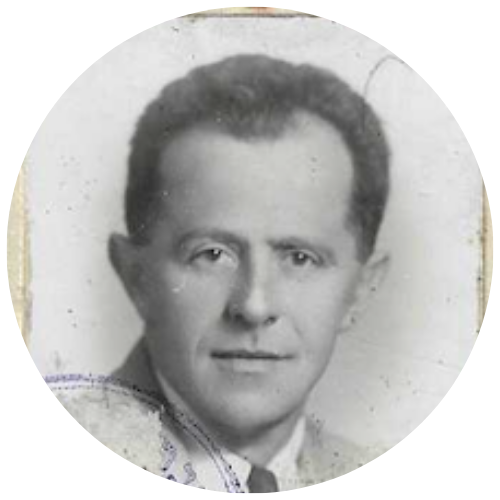
In May 1948, under siege and shortage, Jewish Jerusalem broke through imposed barriers, reclaimed neighborhoods, and—despite hunger, darkness, and loss—built its own municipality, proving its resilience and resolve to endure and rebuild.
The battle for the liberation of Jerusalem continues. The Jews did not initiate this battle, nor did the Jews of Jerusalem bring turmoil to the Holy City. They were attacked by many enemies who rose up to destroy them. At first, these enemies tried to restrict the steps of Jewish Jerusalem with barriers and dragon’s teeth[1], attempting to set limits on its future development by defining borders. They sought to distance Jewish Jerusalem from the rock from which it was hewn—the Old City, within the walls of its glorious past as the City of David. All these schemes failed, and all threats had no effect. The Jews of the Jewish Quarter in the Old City, those who have guarded the walls for generations, were not deterred by the riots of Haj Amin’s followers, neither in the past and not now. The Jewish community in the Old City never ceased to exist.
After all attempts of persuasion and threats failed, the unnatural boundaries were breached, and the Jewish area of Jerusalem expanded overnight. The lands that had been taken from the Jewish community by British rule were reclaimed. However, not all areas were recovered. There are still territories that were once home to a large and thriving Jewish community, now under Arab control, where Jews were murdered and their inheritance as the descendants of Jacob[2] was claimed by others.
The Jewish residents of the Musrara neighborhood were forced in the 1930s to retreat to newly conquered areas taken from the wilderness. This retreat led to the establishment of neighborhoods like Rehavia, Kerem Avraham, Tel Arza, and expanded Beit HaKerem, Bayit VaGan, Kiryat Shmuel, and many more. However, the Jewish community of Jerusalem never forgot the magnificent synagogues that once stood in the Musrara neighborhood near the Damascus Gate and within the Damascus Gate area.
The burning of Jewish merchants’ shops on David Street in the Old City during the 1929 riots led to the establishment of a new commercial center. The construction of Bevingrad two years ago brought about the creation of another commercial center further up Jaffa Street. However, the Jews never relinquished their rights to their property and sources of livelihood.
And now, the long-awaited day has arrived. The people of Jerusalem have broken through the barriers, removed the obstacles, and returned to many of the neighborhoods from which they had been expelled by foreign and oppressive hands. On the eve of the establishment of the State of Israel, the boundaries of Jewish Jerusalem have once again expanded, and the battle for its complete liberation continues. The siege is weakening. The people of Jerusalem, who have always been scholars, lovers of legend, and fond of intricate debate, have also proven their ability to stand at the gates against a cruel enemy. Jews of all ages and social classes have enlisted en masse for national service. Offices have closed, industrial and workshop labor has been reduced, and clerks, workers, yeshiva students, and teachers have all gone out to defend the capital of the Holy Land.
The suffering caused to Jerusalem’s Jews by their isolation from the State of Israel has strengthened its residents for what lies ahead. If all of Israel has become a front and a battlefield, then Jewish Jerusalem is at the very frontline of the battle for the Jewish settlement. And this Jerusalem – it knows how to stand in battle. It knows how to rejoice, and also, when necessary, to suppress its joy or its grief.
I stood by the bedside of a Jerusalemite in the hospital. His mother, a woman born in Jerusalem from the old Yishuv, came to visit her critically wounded son. Not a single tear was shed, nor did a sigh escape from her wounded heart. “It’s nothing, my child. We will see better days,” she gently told her son. And like her, many mothers in Israel say the same today.
We will be rebuilt—and we will rebuild[3]
Jerusalem not only bears the suffering of war in physical wounds but also lovingly endures wounds of the spirit. Everything will pass. Kfar Etzion will rise and flourish again. Atarot and Neve Ya’akov will be rebuilt because the Jews are indeed a stiff-necked people, and the Jerusalemites are seventy-seven times as stubborn.
For weeks now, Jerusalem has suffered from a lack of water supply. Yet, with goodwill and mutual assistance among those under siege, the people of Jerusalem overcome even this hardship. There are no complaints. Everyone praises the arrangements restored by the Jerusalem municipality in the Jewish sector—despite its lack of resources, it managed within a few days to organize a more or less fair distribution of water for the capital’s residents. True, people stand in line for hours to receive a few buckets of water. But what of it? In the early days of British rule in Jerusalem, we —young and old—stood all day and night by the taps and received no water at all. Today, despite the harsh siege, there is a daily water distribution.
If there is no electricity, the situation is indeed difficult, but the Jews of Jerusalem know how to manage without it. Fires are lit in stoves that have worn with age and were brought out from the cellars of the recent past. Are the streets unlit at night? True, but Jerusalem has never enjoyed abundant street lighting at night, even though it is entitled to illumination in return for its money.
Water and electricity are not the only essential commodities that Jewish Jerusalem lacks. But everyone understands the necessity of endurance. Everyone appreciates that this suffering is not in vain. “According to the suffering—so is the reward.” Plans are already being made for the development, prosperity, and glorification of Jewish Jerusalem. And when the Jews of Jerusalem begin something, one can be certain they will see it through to completion. These are not just plans. We can already point to significant achievements Jewish Jerusalem’s development. Who, six months ago, would have dreamed of a Jewish municipality in Jerusalem?
The Jewish municipality of Jerusalem has become a reality. They did not want to grant us a mixed municipality with even 50% Jewish representation. Thus, for the first time in many generations, a fully Jewish municipality was established. Its jurisdiction is expanding. The western and southern neighborhoods, which for years contributed large revenues to the city’s coffers while being denied civic rights and municipal services, have been incorporated into its governance. This Jewish municipality understands its heavy responsibilities. It struggles through birth pains. Its treasury is empty, its institutions are not yet fully organized, and its resources are nearly nonexistent. But its intentions and commitment to serving Jerusalem’s Jewish community are sincere. And the Jewish public appreciates these efforts. People are beginning to pay municipal taxes again, despite the hardships of these difficult days. The city remains clean, which provides encouragement both to its residents and to the municipality.
Jewish Jerusalem has been greatly encouraged by the orderly supply of essential foodstuffs. If, in the early days and weeks of the siege, there were complaints—often justifiably so—due to the unfair distribution of supplies, however, since the introduction of ration books, many of these grievances have been resolved. Food distribution is improving. There is still room for improvement, but patience is needed. And patience is something the people of Jerusalem have had for generations. Because their patience has sustained them through all generations, and it will sustain them through these difficult times of trial and tribulation.
[1] Dragon’s teeth are pyramidal anti-tank obstacles of reinforced concrete first used during the Second World War to impede the movement of tanks and mechanised infantry.
[2] Genesis 28:4, Isaiah 58:14, Kings I 21:19
[3] Jeremiah 31:3